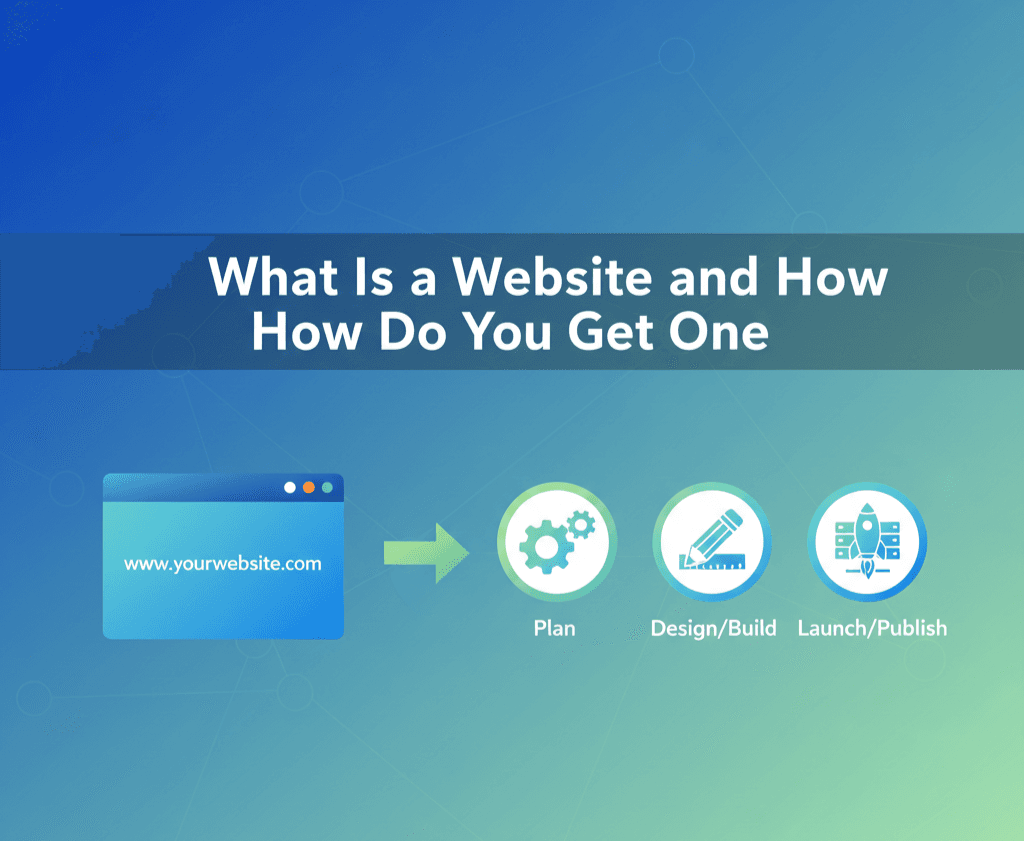
The Business Owner’s Guide: What Is a Website and How Do You Get One?
As a business owner, you don’t need to know how to write code any more than you need to know how to refine gasoline to drive a car. You just need to know how to steer.
In 2026, the digital world is crowded. To clear the air, we’ve put together this straight-to-the-point guide on what a website actually is for you and the practical steps to getting one live.
What Is a Business Website (Really)?
Forget about "code" and "servers." From a business perspective, your website is your Digital Sales Representative.
It is a 24/7 employee that:
- Introduces your brand to people who have never heard of you.
- Answers the same 10 questions you get asked every day (saving you hours of time).
- Collects money or leads while you are at home with your family.
In 2026, a website is no longer a luxury; it is your proof of existence. If an AI assistant or a customer can’t find your website, to them, your business simply doesn't exist.
How Can You Make a Business Website? (The 3 Real Options)
There are three ways to get your business online. The "right" way depends on your budget and how fast you want to grow.
Option 1: The "Do-It-Yourself" Builders (Time-Heavy)
Platforms like Wix, Squarespace, or Shopify allow you to "drag and drop" a website into existence.
- Best for: Brand new startups with more time than money.
- Pros: Low upfront cost; you have total control.
- Cons: You have to do the writing, the design, and the troubleshooting. It often looks "DIY," which can hurt your credibility.
Option 2: The "Freelancer" Route (Variable Quality)
You hire an individual to build the site for you.
- Best for: Small projects with a limited scope.
- Pros: Cheaper than an agency; personal contact.
- Cons: If the freelancer gets sick or busy, your project stops. They often focus only on the "look" and ignore the "strategy" (SEO and AI-readiness).
Option 3: The "Professional Agency" Partner (Growth-Focused)
This is where a team like Softwara comes in. You aren't just buying a website; you are buying a business outcome.
- Best for: Established businesses ready to scale and look professional.
- Pros: Everything is handled—strategy, design, speed optimization, and security. It’s built to rank on search engines from day one.
- Cons: Higher initial investment.
The 4-Step Roadmap to Launch
Regardless of which option you choose, the process follows these four steps:
1. Claim Your Name (The Domain)
First, you need to buy your domain (e.g., www.YourStore.com). Keep it short, avoid hyphens, and make sure it’s easy to say over the phone.
2. Choose Your Strategy
Decide what the "Win" looks like. Do you want people to call you? Fill out a form? Buy a product? Your website should be designed around that one primary goal.
3. Gather Your "Assets"
You will need:
- Words: What do you do, and how do you help?
- Photos: Real photos of your work or your team.
- Social Proof: Reviews from happy customers.
4. The Build & Test
This is where the site is actually constructed. Before going live, you must check it on a phone, a tablet, and a laptop to ensure it looks perfect everywhere.
The Verdict: Your Website Is Your Foundation
Building a website is the single most important marketing move you can make in 2026. It is the only part of the internet that you own 100%.
Whether you want to spend your weekend building it yourself or you want a professional team to deliver a high-performance machine, the most important thing is to start.
Stop losing customers to the competition because they found their website first.